Sea Water Desalination
Reverse Osmosis (RO)Decades before, if any desalination plant wanted to be built, the only viable option was “Multi effect flash distillation/evaporation (MED)” by creating vacuum and usage of heat from lean or recovered steam. Years after years (especially in 80s and 90s) with development of PTFC (polyamide thin-film composites) material and innovative bundling design (spiral wound) made the concept of RO membrane desalination possible. In late 90s and early 2000s, MED was still the predominant way for desalination of sea water if the capacity of the requirement were above certain threshold (typically above 37000~38000 m3/day – ten million gal/day – MGD) and RO was competitive when the capacity was between 1-10 MGD; but yet again after further production cost reduction of RO membranes modules, wide spread designs, renewable electricity, and better process/operation optimization techniques, RO desalination recently become the number one and first choice “regardless” of the target capacity. As of 2025, more than 70% of current “global” desalination operations are based on RO with the biggest plants in UAE (AL Taweelah) and KSA (Alkhobar 2) with capacity of 909000 & 750000 m3/day (240 and 185 MGD) respectively with world low-record cost of 0.4 USD per 1000 gallons of fresh/potable water!!!
Seawater typically has a salt concentration of 3.2–5.0 % vol. (above 35000 ppm), depending on the region of the world. Because of this high salinity, only membranes with salt rejections of 99.3 % or more can produce potable water in a single pass. Application to seawater desalination of the first-generation cellulose acetate membranes, with rejections of 97–99 %, was limited. With the development of the polyamide interfacial (thin film) composites, suitable seawater membranes became available, and many plants have been installed.
The typical osmotic pressure of seawater (dependent on salinity) is about ~24 bar (350 psi), and the osmotic pressure of the rejected brine can be as much as 41 bar (600 psi). In early years, seawater reverse osmosis plants operated at very high pressures, up to 100 bar (1500 psi), but as membranes improved, operating pressures dropped to 55~70 bar (800–1000 psi).
Typical seawater plants do not operate at a recovery rate of more than 35–45 % because of the high brine osmotic pressure; at this modest recovery rate, more than half of the feed water leaves the plant as pressurized brine. Because of the high pressures involved in seawater desalination, recovery of compression energy from the high-pressure brine stream is almost always worthwhile. This can be achieved with a hydro-turbine linked to the high-pressure feed water pump, lowering total power costs by as much as 30 %.
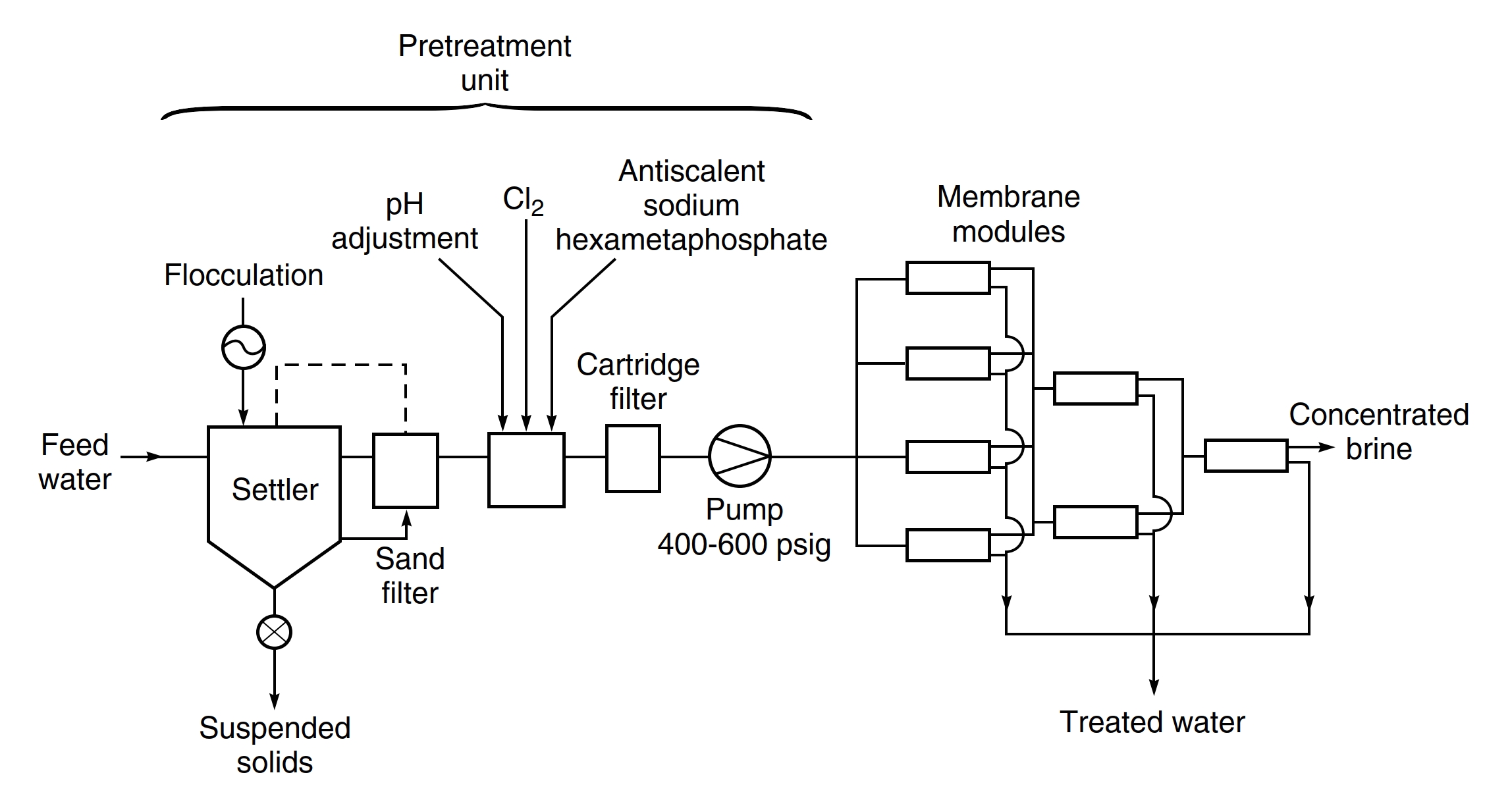
Raw seawater requires considerable pretreatment before it can be desalinated, but these pretreatment costs can be reduced by using shallow sea-front wells as the water source. The SDI of this water is usually quite low, and little more than a sand filter may be required for particulate control. However, sterilization of the water and addition of anti-scalants will still be necessary.